How to Investigate Jitter During Industrial Robot Operation? A Layered Diagnosis from Mechanical Backlash to Servo Feedback
When jitter occurs during robot low-speed crawling, trajectory corners, or specific axis movement, it should not be directly attributed to motor or reducer damage. It is necessary to combine alarm records, occurrence posture, and single-axis tests to sequentially check mechanical load, transmission components, encoder feedback, and servo control status.
Dans cet article
01. First, Record the Conditions Under Which Jitter Occurs
Confirm whether the anomaly appears during automatic operation, manual low-speed operation, or specific trajectory segments, and record the corresponding axis, speed, load, posture, and alarm history. If it operates normally under no load but jitters under load, priority should be given to verifying tool weight, center of gravity, inertia settings, and whether the fixture is loose. If it only occurs in fixed postures, attention should be paid to the pulling of the body cables, connector contact, and joint transmission status.
02. Check Mechanical Transmission and Installation Foundation
After shutdown and performing safety isolation, check the tightening of the base, flange, and fixture, and observe whether there is abnormal backlash, friction noise, or periodic vibration in the joints. Reducer wear, bearing abnormalities, incomplete brake release, and loose external axis couplings can all manifest as low-speed jitter. Do not rely solely on increasing speed or modifying gains to mask mechanical problems.
03. Troubleshoot Motor and Feedback Loop
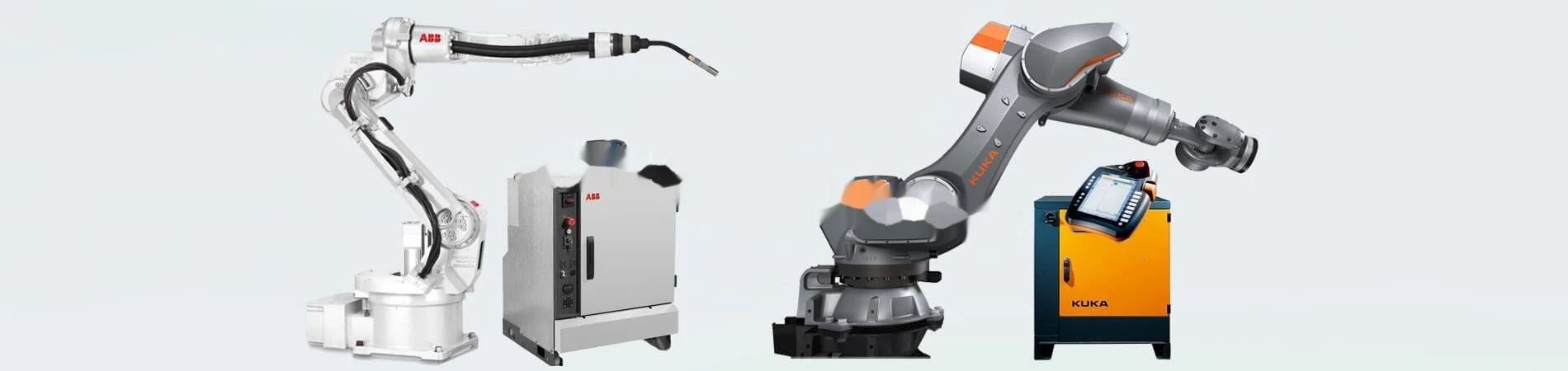
Check whether the servo motor power cables, encoder cables, and connectors inside the cabinet are loose, contaminated, or damaged. Unstable feedback signals may cause speed fluctuations, but encoder alarms can also be caused by cable, shielding, grounding, or power supply abnormalities. For ABB, FANUC, KUKA, and YASKAWA equipment, analysis should be based on their respective controller diagnostic records to avoid applying parameters across brands.
04. Verification Methods After Repair
After completing industrial robot repair, original parameters should be restored and verified. Single-axis, no-load, and actual load tests should be conducted at safe speeds, while checking trajectory smoothness, repeat positioning, temperature rise, and alarm records. The robot maintenance file should preserve fault posture, test results, replaced components, and verification conclusions to facilitate the identification of recurring issues.
Robots industriels de réparation Hotline: +86 18122009539
Contacter l'ingénieur de réparation : +86 18122009539
Line Down? Get Urgent Parts, Board Repair or On-Site Support
Share your robot model, part number, alarm code and location. We provide spare parts sourcing, component repair, on-site installation/commissioning and preventive maintenance.