
Worth Collecting! A Complete Analysis of Industrial Robot Repair Technology
Meanwhile, the future market for industrial robots in mainland China is promising. It is predicted that this market will maintain a high growth rate of at least 30% over the next thirty years. Faced with such an attractive market opportunity, major global robot brands are gearing up to actively expand their business presence in mainland China, including giants like FANUC, Yaskawa Electric, ABB, and KUKA.
Archive article: time-sensitive statements reflect the original material and are not a current news update.
Due to the extremely high entry barriers in the robot industry, there are very few top players in the global robot market. The top four manufacturers—Japan's FANUC robot repair and Yaskawa robot repair, along with Switzerland's ABB robot repair and Germany's KUKA robot repair—firmly hold 50% of the global market share thanks to their outstanding technology and capabilities.
Meanwhile, the future market for industrial robots in mainland China is promising. It is predicted that this market will maintain a high growth rate of at least 30% over the next thirty years. Faced with such an attractive market opportunity, major global robot brands are gearing up to actively expand their business presence in mainland China, including giants like FANUC, Yaskawa Electric, ABB, and KUKA. They are seizing first-mover advantages in the mainland Chinese market, establishing factories with the aim of cultivating this fertile ground deeply and reaping substantial rewards.
Although mainland China has achieved initial results in the industrialization of industrial robots, there remains a significant gap compared to foreign manufacturers. Domestic industrial robots still show deficiencies in precision, speed, and other aspects, leading to a relatively low degree of product industrialization and a limited market share. The technological level of some domestic robots can only be compared to foreign products from the mid-1990s, which undoubtedly sounds an alarm for the development of China's robot industry.
Li Xiaojia, Director of the Data Statistics Center of the China Robot Industry Alliance, once pointed out that in 2013, China purchased and assembled nearly 37,000 industrial robots. Foreign-brand robots, primarily 6-axis or higher-end industrial robots, nearly monopolized high-end sectors such as automotive manufacturing and welding, accounting for as high as 96%. Domestic robots, on the other hand, were mainly applied in low-end fields like handling and loading/unloading, making it difficult to compete with foreign brands.
More worryingly, the development gap between China's robot industry and foreign counterparts shows a trend of further widening. China's robot industry is still in its infancy, with insufficient brand recognition for industrial robots. Even the largest robot enterprises have an annual production of only a few thousand units. As foreign robot companies increasingly establish China as a production base, the development space for domestic independent-brand industrial robot enterprises will undoubtedly be further squeezed.
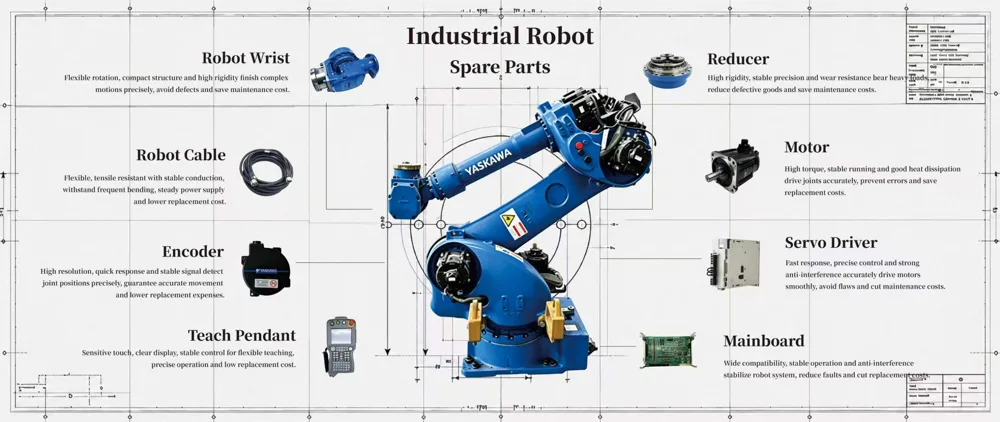
When discussing the key basic components of robots, we must mention their four major parts: the body, servo system, reducer, and controller. The body accounts for 22% of the cost, the servo system for 24%, the reducer for 36%, and the controller for 12%. These key basic components constitute the robot's transmission system, control system, and human-machine interaction system, playing a crucial role in the robot's performance. They are characterized by universality and modularity and are indispensable core components of robots. Specifically, the key basic components of robots mainly include high-precision robot reducers, high-performance AC/DC servo motors and drives, and high-performance robot controllers.
Industrial robots can also be classified according to different methods. Faced with the current situation of foreign brands monopolizing the domestic market, experts have offered various suggestions, proposing to seek "breakthroughs" and catch up through multiple avenues. Strengthening the tracking and research of international robot technology, formulating a practical "Robot Technology Roadmap" that aligns with China's development, and clarifying the steps for technological development, the key core technologies to be broken through, the processes and components, as well as the industrialization path, are undoubtedly among the most urgent tasks at present.
Archive Number: 23112. Content compiled from the old site database.