
ABB Teach Pendant Repair for Joystick Response Faults
Diagnose an ABB FlexPendant joystick that does not command motion by checking operating state, selections, connections, logs, and hardware evidence.
In this article
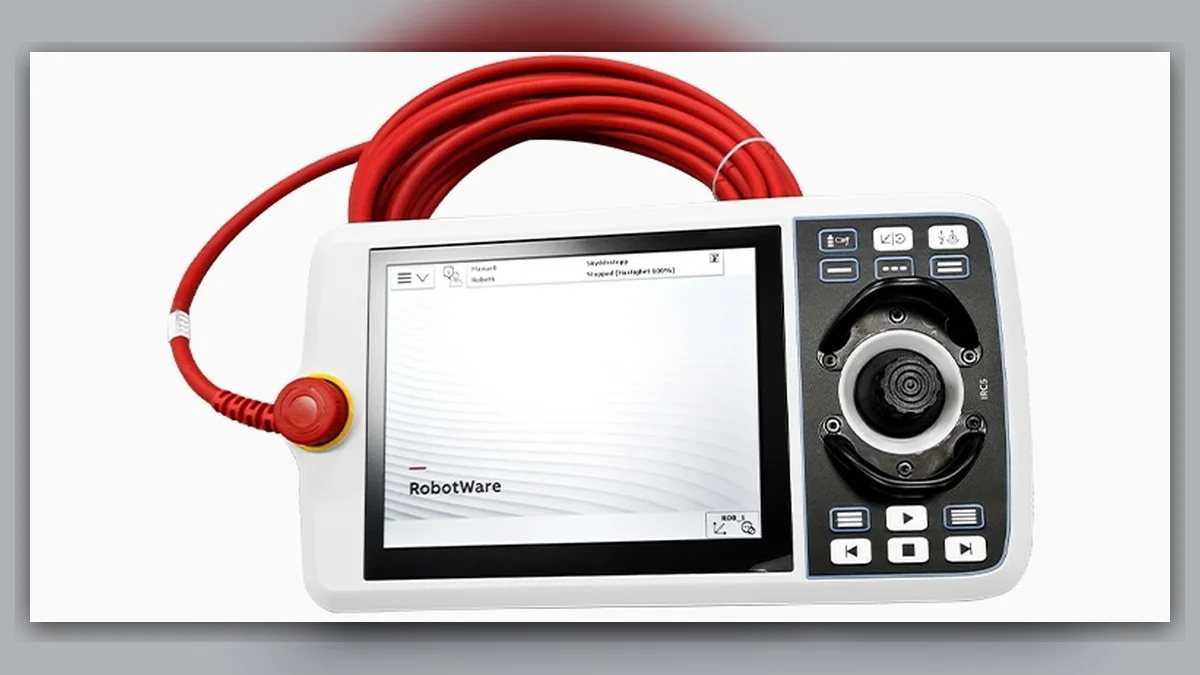
ABB teach pendant repair may be required when a FlexPendant joystick does not command the expected robot movement, but the symptom alone does not prove that the joystick is damaged. Motion can also be blocked by the operating state, safety chain, selected mechanical unit, coordinate settings, controller status, or pendant connection. Before resetting or disconnecting anything, record the complete message text, affected axis or motion unit, operating conditions, and whether other pendant functions remain responsive. This evidence separates an input-device problem from a system-level motion inhibit.
Symptoms and Scope
This diagnostic process applies to ABB robot systems using a FlexPendant where the display and interface operate, but joystick movement is absent, intermittent, limited to certain directions, or inconsistent with the selected motion command. Exact menus, safety architecture, pendant versions, and controller interfaces vary by installed system.
The procedure does not cover a completely blank pendant, a confirmed touchscreen-only fault, or an obvious cable connection alarm. It also does not assume that a robot refusing to move has a defective pendant. Active safety conditions, an incorrect mechanical-unit selection, an unsuitable coordinate system, a motion restriction, or a controller alarm can produce a similar observation.
Information to Record First
Preserve the evidence before clearing alarms or changing selections. Record whether the problem affects every joystick direction, one direction, one axis, or one mechanical unit. Note whether the fault is continuous or intermittent and whether it appeared after maintenance, a pendant exchange, a software change, or an impact.
Complete alarm code and full text:
Date and exact time:
Faulted axis:
Robot position/posture:
Program step or motion:
Actual speed and load condition:
Reset result:
Time until recurrence:
Related power, communication or feedback alarms:
Also record the robot model, controller model, FlexPendant part number, hardware revision, connector arrangement, and visible label information. These identifiers are necessary because physical compatibility cannot be established from appearance alone.
Safety and Preparation
Place the robot in a safe condition according to the site risk assessment and applicable ABB operating information. Keep personnel outside the safeguarded space unless an approved procedure specifically permits access. Do not bypass an emergency-stop circuit, guard interlock, enabling function, or other protective device to test joystick response.
Inspecting internal pendant hardware should be left to competent repair personnel using suitable electrostatic-discharge controls. Do not repeatedly flex a damaged cable, force a connector, or reproduce an intermittent problem through actions that could increase equipment risk.
ABB Teach Pendant Repair Diagnostic Sequence
- Confirm the controller state. Record active alarms and review the alarm history before resetting anything. If the controller reports a safety, drive, communication, or motion-permission condition, resolve that documented state through the applicable system procedure before treating the joystick as the primary suspect. A robot that is not permitted to move cannot validate joystick operation.
- Verify the intended motion selection. Confirm the selected mechanical unit, motion mode, coordinate system, and axis or linear movement selection shown on the pendant. Compare these selections with the movement the operator expected. If correcting a selection restores normal response, retain the event record and investigate why the setting changed rather than replacing pendant hardware.
- Compare joystick directions. Without creating an unsafe motion condition, determine whether the issue affects all directions or only a repeatable direction. Observation under motion may be performed only by suitably competent personnel, under controlled conditions, and in accordance with manufacturer information and the site safety procedure. A single repeatable direction that fails while other directions register normally can support focused joystick inspection. A total absence of motion still requires controller and safety-state checks.
- Check other pendant functions. Observe whether menus, buttons, and displayed status continue to respond normally. If several unrelated inputs fail together, the investigation should include pendant communication, cable condition, connector seating, and controller interface status. If only the joystick input is abnormal, internal wear, contamination, impact damage, or an electronic input fault may be considered, but each possibility requires inspection or bench testing.
- Inspect accessible external parts. With the equipment safely isolated where required, check the joystick boot and surrounding enclosure for cracks, contamination, deformation, or evidence of impact. Inspect the pendant cable and accessible connector areas for crushing, sharp bends, looseness, damaged locking features, or contamination. Do not open sealed assemblies or probe live circuits without the correct service information and authorization.
- Review recurrence conditions. Compare the fault with cable position, pendant handling, controller state, and time since startup. A change associated with cable movement may point toward an intermittent connection, while a repeatable directional failure may support a joystick-related branch. Neither observation independently identifies the failed internal part.
How to Distinguish Similar Causes
A joystick hardware fault is more plausible when the controller is ready for permitted manual motion, the correct mechanical unit and movement mode are selected, no relevant system alarm blocks motion, and one or more joystick directions consistently fail to register. A system-level cause is more plausible when all motion is inhibited, alarms are active, selections are incorrect, or several pendant functions fail simultaneously.
Mechanical resistance or an axis fault should not be diagnosed from pendant response alone. If the interface registers a command but the axis does not move, continue with controller, drive, feedback-related component, motor, brake, cabling, and mechanical diagnosis only when alarms and system evidence support those branches.
When Repair or Replacement May Be Considered
Professional bench inspection may be appropriate when external checks and system-state verification isolate the problem to the pendant. Inspection can assess the enclosure, joystick mechanism, cable interface, internal connections, and electronic input processing without assuming in advance which part has failed.
Before installing a replacement pendant or component, match the exact part number, hardware revision, supported controller configuration, and connector layout. Software and configuration compatibility must also be verified for the installed system. A visually similar pendant should not be treated as interchangeable without documented compatibility.
ZHB is an independent industrial robot inspection, repair, and maintenance service provider that also supplies parts to overseas customers. Broader ABB robot repair support is available at https://autonews.best/abb-robot-repair.
Verification After Repair or Replacement
After authorized work, confirm that the pendant starts normally, communicates without related alarms, and registers each intended joystick direction consistently. Verify the selected motion unit and coordinate mode before movement. Controlled motion checks should begin under the applicable reduced-risk operating procedure and be performed only by competent personnel. Confirm that all protective functions remain effective and document the repair, fitted component identifiers, alarm status, and final test conditions.
Information Required for a Repair Inquiry
For an ABB teach pendant repair inquiry, provide the robot model, controller model, complete alarm code and text, alarm history, FlexPendant component label, fault conditions, and clear photographs of the pendant, joystick area, cable, connector, and labels. Describe whether every direction or only a specific direction is affected, whether other controls operate, and whether the symptom changes with cable position. This information helps determine whether pendant testing, cable inspection, or wider ABB robot diagnosis should come first.
Conclusion
A nonresponsive ABB FlexPendant joystick should be diagnosed as an input and motion-permission problem before it is treated as confirmed hardware damage. Record the operating state, verify selections and alarms, compare affected directions, inspect accessible connections and damage, and require matching identification before repair or replacement. Evidence-based isolation reduces unnecessary part replacement and supports safer restart verification.
Need a part or repair assessment?
Share the robot model, part number, fault details and destination country with our team.
Contact our team ↗