
FANUC Robot Repair: Teach Pendant Cable Damage Assessment
Assess visible FANUC teach pendant cable damage, record the installed assembly, and establish safe inspection and replacement criteria before restart.
In this article
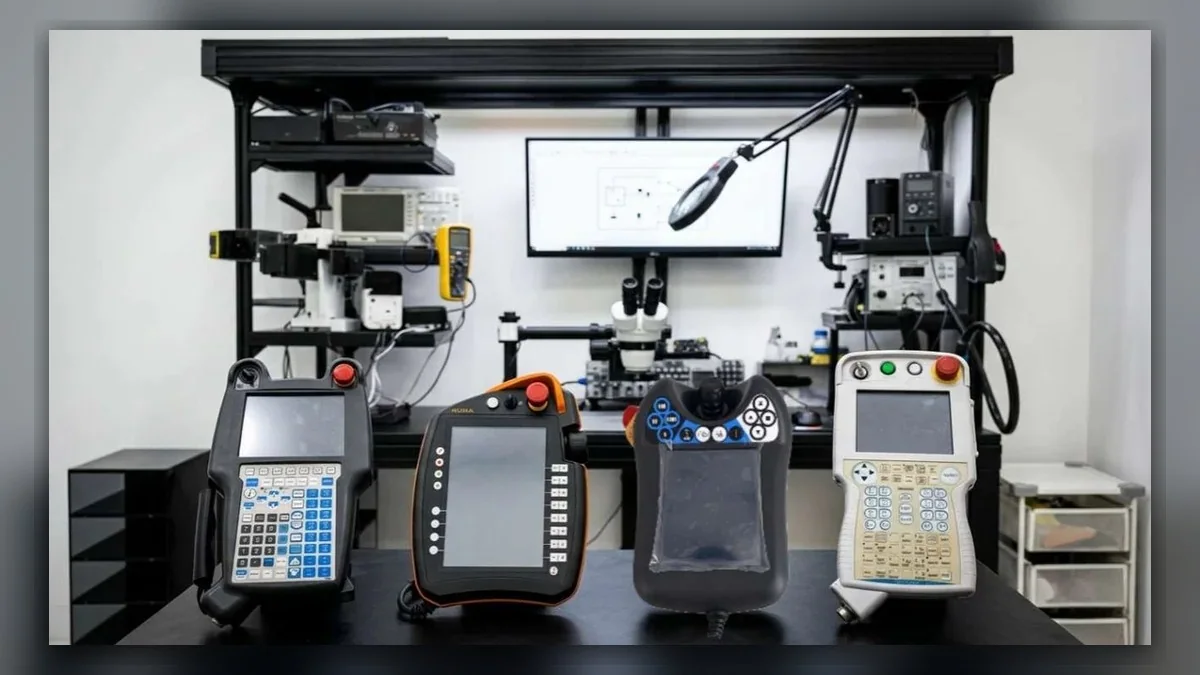
FANUC robot repair for a visibly damaged teach pendant cable starts with securing the robot and identifying the installed pendant, controller, and cable assembly. Cuts, crushing, exposed conductors, or damage near a connector require assessment before continued use. The potentially affected systems depend on the pendant design and its connections, including operator controls and safety-related functions. Record the damage location, operating circumstances, component labels, and any accompanying alarms. External damage alone does not establish which internal circuit is affected or prove that the controller or pendant electronics have failed.
Symptoms and Scope
This article addresses physical damage to the teach pendant cable on FANUC industrial robot systems. It covers assessment and repair decisions for cuts, abrasion, crushing, damaged strain relief, and connector damage. It does not diagnose a blank display, unresponsive keys, or a servo alarm in isolation. Those symptoms need their own diagnostic evidence.
Confirm the exact controller and pendant models before applying any inspection procedure. Cable construction, connection arrangements, and replacement methods depend on the installed equipment. A cable that looks similar is not sufficient evidence of compatibility.
Information to Record First
Photograph the damaged area and the cable route before disturbing the assembly, provided this can be done safely. Record whether the cable was trapped, dragged, stretched, or exposed to a substance. Distinguish observed conditions from suspected causes.
Use this compact fault record when alarms or operating symptoms accompany the damage. Mark unavailable information as unknown and non-applicable items accordingly.
Complete alarm code and full text:
Date and exact time:
Faulted axis:
Robot position/posture:
Program step or motion:
Actual speed and load condition:
Reset result:
Time until recurrence:
Related power, communication or feedback alarms:
Also record the controller, pendant, and cable identifiers. If no alarm occurred, state that explicitly; an absence of alarms does not establish cable integrity.
Safety and Preparation
Remove the affected equipment from operation when conductors are exposed, the cable is crushed, or damage could compromise safe pendant use. Follow the site's isolation procedure and the applicable FANUC instructions before touching damaged wiring, disconnecting connectors, or opening equipment. Isolation and inspection must be performed by suitably competent personnel.
Do not bend the cable repeatedly, move the robot to provoke an interruption, or manipulate a suspect connector while powered. Tape over visible damage does not demonstrate that internal conductors, insulation, or safety-related circuits remain serviceable.
FANUC Robot Repair Diagnostic Sequence
First, use the photographs and incident record to locate the damaged section. Inspect the accessible cable route for pinch points, sharp edges, and places where the cable becomes taut during normal handling. If the route explains the damage, document the hazard and correct it before returning a repaired or replacement assembly to service. If the cause remains uncertain, retain the cable's original routing information for further assessment.
Next, inspect the jacket, strain relief, and connector exterior under the required isolated conditions. Surface marks without visible penetration need assessment against the applicable service criteria. Splits, exposed material beneath the jacket, deformation, or loose strain relief justify withholding the assembly from use pending professional evaluation. Appearance alone cannot confirm the condition of internal conductors.
Then review the alarm history and operator report. A symptom occurring when the pendant was handled may support investigating its cable and connections, but timing alone does not prove causation. Record whether the symptom began before or after the damage was noticed. Refer unrelated or unexplained alarms to their applicable diagnostic procedures rather than attributing every fault to the cable.
Finally, determine what information is missing. An unreadable label, unidentified connector, or uncertain assembly arrangement prevents a reliable replacement decision. Obtain the relevant equipment records and manufacturer documentation before selecting parts or authorizing internal work.
Repair or Replacement Decisions
Professional assessment should establish whether the affected cable is separately serviceable or belongs to a larger pendant assembly. Any electrical testing or internal inspection should follow the applicable manufacturer procedure; this article does not prescribe continuity tests, connector pinouts, or improvised repairs.
For a replacement, match the exact model, part number, hardware revision, and connector layout. Confirm documented compatibility with the installed controller and pendant. Do not assume that matching connector shape establishes electrical compatibility. Preserve identification photographs and inspection findings so the replacement decision remains traceable.
Information Required for a Repair Inquiry
ZHB is an independent industrial robot inspection, repair and maintenance service provider that also supplies parts to overseas customers. For an inquiry through its industrial robot repair service at https://autonews.best/services, provide the robot model, controller model, complete alarm code if present, alarm history, pendant and cable component labels, fault conditions, and clear photographs of the damage, connectors, and cable route. Explain any known crushing, pulling, or contamination event and identify information that remains unavailable.
Verification Before Return to Service
After repair or replacement, verify assembly identification, secure installation, strain relief, and cable routing using the applicable manufacturer instructions. Qualified personnel must complete the required pendant control and safety-function checks before production release.
If operational observation is required, perform it only under controlled conditions, following manufacturer operating information and the site safety procedure. Do not recreate the damaging event. Record the inspection outcome, functional verification, and routing correction in the FANUC robot maintenance history; successful startup alone does not establish that the original hazard has been removed.
Need a part or repair assessment?
Share the robot model, part number, fault details and destination country with our team.
Contact our team ↗