
How to Integrate Industrial Robots with CNC Machine Tools?
How to integrate industrial robots with CNC machine tools? With the transformation and upgrading of China's equipment manufacturing industry, driven by both market demand and technological progress, the integrated application of industrial robots and CNC machine tools has developed rapidly in recent years. The forms of application are continuously expanding, bringing new impetus to the current trend of machine tool intelligence, and it will certainly play a beneficial role in promoting the transformation and upgrading of China's machine tool industry.
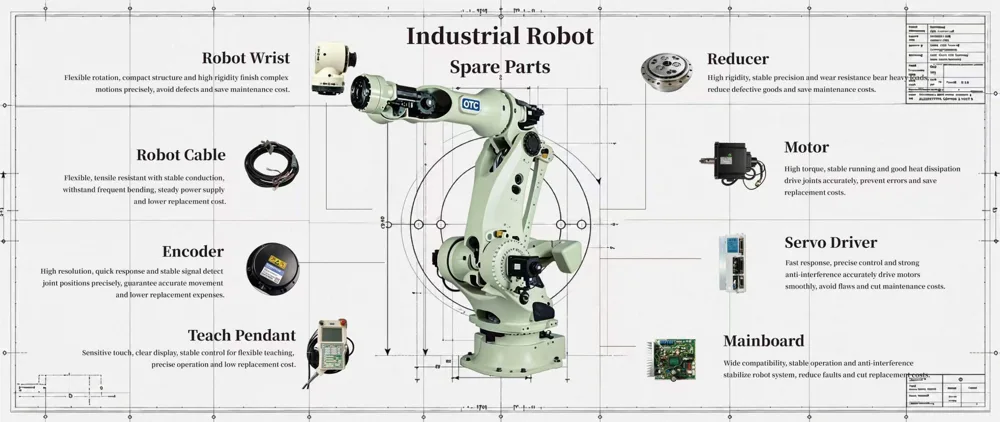
Archive article: time-sensitive statements reflect the original material and are not a current news update.
With the transformation and upgrading of China's equipment manufacturing industry, driven by both market demand and technological progress, the integrated application of industrial robots and CNC machine tools has developed rapidly in recent years. The forms of application are continuously expanding, bringing new impetus to the current trend of machine tool intelligence, and it will certainly play a beneficial role in promoting the transformation and upgrading of China's machine tool industry.
Given the current development status of robot development and their integrated application with machine tools, how should relevant enterprises establish effective organizational liaison mechanisms to strengthen communication and cooperation? What kind of technical specifications and standards should be established for the integrated development of the two industries to fully achieve resource sharing and complementary advantages, and to form a synergistic force for industrial development!
The robot industry is ushering in a golden period of development opportunities. How to promote the integrated development of the industrial robot industry and the machine tool industry, and how to achieve the mutual integration and application of industrial robots and CNC machine tools, have become important topics for the industrial upgrading of the modern equipment manufacturing industry.
Many positions in the machine tool manufacturing process rely heavily on workers' physical strength and skills, resulting in low production efficiency, high labor intensity, a lack of skilled technical personnel, and difficulties in ensuring product stability and consistency. This has prompted the machine tool industry to increasingly adopt industrial robots and intelligent manufacturing technologies to transform traditional process flows. In the past, expensive imported robots and production lines were mainly used in a few industries such as automobiles, and their application proportion in equipment manufacturing fields like the machine tool industry was relatively low, largely restricting the improvement of automation levels in the domestic machine tool industry.
1 Current Status of the Two Major Industries
After the "Eleventh Five-Year Plan" and "Twelfth Five-Year Plan", a decade of dedicated effort, the development of China's CNC machine tool industry has entered a stage of medium-grade mass production and high-grade small-batch production. The overall level of the industry has basically reached international competitiveness. As the control brain of CNC machine tools, CNC systems, such as FANUC robot maintenance, domestic CNC system manufacturers have mastered control technologies like five-axis linkage, small line segment interpolation, and dynamic error compensation. They have also developed high-performance, high-power servo drive devices. Independent research and development have promoted technological innovation and progress, and have also given rise to the embryonic form of the industrial robot industry, fostering industrial growth.
Currently, CNC system development enterprises, complete machine tool enterprises, automation application integrators, and even real estate capital giants are attempting to enter the robot field, setting off a wave of robot industry investment. Worryingly, issues such as "land enclosure for subsidies" caused by excessive policy guidance, overcapacity from excessive industrial investment, and low-end homogeneous competition due to a lack of innovation-driven development, will all lead the robot industry into disorderly development. It is worth pondering: what kind of enterprises are most suitable for developing industrial robots?
How to improve the overall quality of the robot industry? Generally speaking, enterprises with a foundation in CNC systems, capable of mass-producing control systems, servo motors, and servo control systems, have certain advantages. The industrial promotion roadmap of Japan's FANUC Corporation is a successful typical case worthy of reference.
Several domestic CNC system enterprises have entered the industrial robot industry. Guangzhou CNC, being one of the first, has been planning and developing the industrial robot industry since 2006, spanning 8 years. Leveraging its accumulated experience in producing controllers, servo drives, and servo motors, Zhonghengbiao Machinery has completed the fully independent development of a series of industrial robots, with products covering 3~200kg, including functions such as handling, machine tool loading/unloading, welding, palletizing, gluing, grinding/polishing, cutting, spraying, sorting, and assembly.
With the prominence of issues such as rising labor costs, a shortage of skilled personnel, hazardous environmental conditions, and high-intensity operations, the participation of industrial robots in production and manufacturing has been widely recognized and increasingly used, becoming a focus of social attention. The government is using this to promote industrial transformation and upgrading, while enterprises are using it to carry out technological transformation, change production methods, and improve operational efficiency. However, China's robot stock is not large, domestic brands are still being cultivated, and comprehensive competitiveness needs to be improved. So, in what mode will the robot industry develop forward? The author believes that at this stage, there is a greater need for collaborative development among the entire robot machine enterprises, key robot component suppliers, and robot integrators in the industrial chain.
2 Integration Methods for Robots and CNC Machine Tools
In the field of CNC machine tool processing applications, the integrated application of domestic machine tool loading/unloading robots and CNC machine tools is already among the forefront of development. Significant changes have also occurred from the perspective of industry application levels:
(1) Work Cell: Single robot linked to a single machine tool for processing, single robot linked to multiple machine tools for processing.
(2) Flexible Manufacturing System (FMS): A flexible machining line based on network control, using a PLC control platform. Through industrial Ethernet bus methods, multiple robots, multiple CNC machine tools, and their auxiliary equipment are networked and grouped into a line, performing orderly automatic production according to a cycle time.
(3) Digital Workshop: Utilizing CAD/CAM/CAPP/MES auxiliary production tools, logistics technology, and sensing technology, KUKA robot training, it possesses functions such as production process monitoring, real-time online fault feedback, machining process data management, tool information management, equipment maintenance data management, and product information recording. It meets the demand for unmanned machining and realizes the production planning, job coordination integration, and optimized operation of the machining system.
(4) Smart Factory: Utilizing intelligent workshop layout and ERP information management systems, it will maximize innovation in traditional production methods. The database of the information management system can interface with various external information systems through gateways, connecting the workshop to the ERP system to query workshop production status and achieve efficient allocation of enterprise resources; utilizing its SMS platform and email platform, it can provide real-time reports to administrators on equipment failures, production progress, and other information.
3 Pathways for the Integrated Development of Industrial Robots and CNC Machine Tools
- In terms of Processing and Manufacturing
Robots participating in the processing and manufacturing of machine tool structural components to achieve automation, special-purpose machine tools serving the precision machining of robot-specific reducers, improving processing quality and batch production efficiency, etc., have great potential for integrated development. Through strategic cooperation between enterprises, robot companies can leverage the manufacturing and process technology capabilities of machine tool manufacturers to achieve the following goals:
(1) For robot body castings and reducer structural components, jointly research and develop batch precision manufacturing technologies, improve the batch production capacity and process level of robots, overcome reliability and consistency technologies, and achieve efficient, stable, and precise cycle time production.
(2) For robot tooling, fixtures, and the integration capability of machining production lines, leverage the extensive end-customer channel resources of major machine tool factories to commission and promote the application of robots.
(3) Develop industrial robots urgently needed for automation and flexible production, such as for loading/unloading on single machine tools and production lines, and for part handling, scraping, chamfering, polishing, welding, spraying (powder), etc. Machine tool enterprises and industrial robot enterprises jointly develop these to achieve automatic processing of complete machine components and promote the improvement of machine tool production and manufacturing technology levels.
(4) Key mechanical components of industrial robot bodies, such as turntables, large arms, boxes, support sleeves, small arms, and wrist bodies, have high requirements for dimensional accuracy and geometric tolerances, placing high demands on mechanical processing equipment, tooling fixtures, measuring and inspection tools, etc.; the structural optimization and processing of key parts of robot reducers, such as cycloidal gear housings, planetary pinwheels, eccentric shafts, and planet carriers, are currently difficult for domestic processing equipment, assembly processes, and precision detection to achieve. However, based on using domestic CNC machine tools and tooling equipment to complete related processing, Yaskawa robot maintenance, will help improve China's high-end precision mechanical component design and processing levels, and promote the application and development of domestic CNC devices and domestic CNC machine tools.
Archive Number: 11147. Content organized from the old site database.