
Industrial Robot Repair After Control Cabinet Water Ingress
Learn how to assess an industrial robot control cabinet after water ingress without unsafe restart attempts or unsupported component replacement.
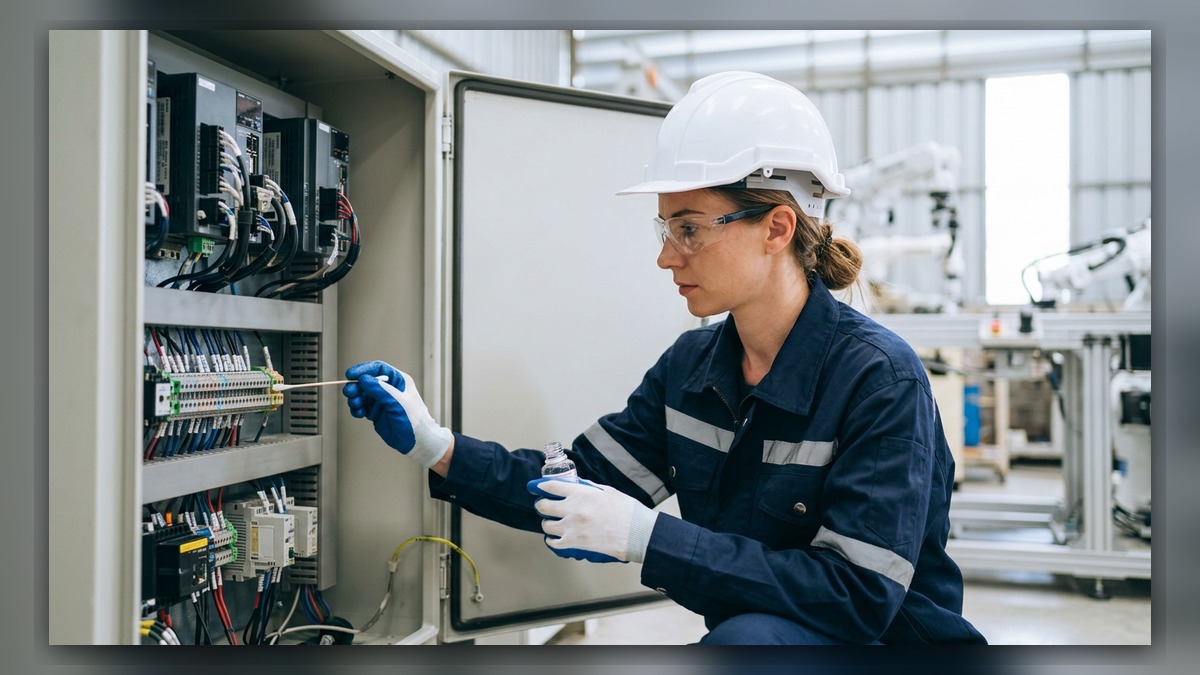
Water inside an industrial robot control cabinet requires immediate isolation and a controlled inspection before any restart is attempted. Potentially affected systems include the incoming power section, controller boards, servo drives, safety circuits, connectors and cooling equipment. Record the robot and controller models, alarm history, operating state and source of the liquid before disturbing the evidence. A wet cabinet, tripped protective device or startup failure does not independently prove that a drive or controller board is permanently damaged.
Symptoms and Scope
This diagnostic approach applies to clearly identified general industrial robot systems, including ABB, FANUC, KUKA and YASKAWA installations, where water, coolant, condensation or another liquid has entered or may have entered the control cabinet. It addresses the assessment stage before industrial robot repair decisions are made.
It does not replace the manufacturer’s model-specific safety instructions, drying requirements or insulation-testing procedures. Cabinet construction, internal voltages, stored-energy devices and approved test methods vary by controller. A robot that appears dry externally may still have contamination beneath modules, inside connectors or along cable channels.
Possible observations include a cabinet power loss, protective-device operation, abnormal startup, communication errors, drive-related alarms, visible moisture, corrosion deposits or an unusual odor. These observations help define the inspection area, but none identifies the failed component by itself.
Information to Record First
Preserve the controller state and collect evidence without repeatedly resetting or energizing the equipment. Record whether the robot was operating, idle or powered down when the ingress occurred. Identify the liquid source, affected cabinet area and any nearby maintenance activity. Photographs taken before cleaning can help establish the contamination path.
Complete alarm code and full text:
Date and exact time:
Faulted axis:
Robot position/posture:
Program step or motion:
Actual speed and load condition:
Reset result:
Time until recurrence:
Related power, communication or feedback alarms:
Also record the robot model, controller model, cabinet identification, installed options and labels of visibly affected modules. Note whether the substance was clean water, coolant, cleaning solution or an unidentified liquid. Different residues can create different contamination and corrosion risks, so the substance should not be assumed from appearance alone.
Safety and Preparation
Stop operation and isolate the equipment according to the site’s electrical safety procedure and the applicable manufacturer information. Access should be restricted to suitably competent personnel. Stored electrical energy may remain after incoming power is disconnected, and wet or contaminated surfaces can introduce additional hazards.
Do not energize the cabinet simply to see whether it still works. Do not bypass protective devices, safety circuits or interlocks. Repeated reset attempts can obscure the original alarm sequence and may worsen damage if conductive contamination remains present. Cleaning agents, compressed air, heat sources and insulation tests should not be applied unless their use is approved for the installed equipment and performed by qualified personnel.
Industrial Robot Repair Diagnostic Sequence
First, identify the ingress path. Inspect the cabinet roof, door seals, cable entries, heat-exchanger interfaces and nearby piping without dismantling energized equipment. The target is to determine where the liquid entered and which internal areas may have been exposed. If the source remains active or unidentified, correct or contain it before cabinet recovery proceeds.
Second, review the alarm history and event sequence. Determine whether the first recorded event was related to incoming power, cabinet control power, communication, safety or a servo system. Later alarms may be consequences of the initial interruption. If records are incomplete, retain that uncertainty rather than assigning the fault to the last module named in the log.
Third, perform a de-energized visual inspection under the applicable service procedure. Look for moisture tracks, residue, corrosion, discolored surfaces, damaged wiring, contaminated filters and deposits around connectors or module vents. Inspection boundaries should follow the known path of the liquid rather than focusing only on the component associated with the final alarm.
Fourth, verify identifiers before removing or substituting any part. Record the exact model, part number, hardware revision and connector layout of the controller, drive or board. Similar-looking components may not be interchangeable. Cable and connector positions should be documented so that configuration errors are not introduced during inspection.
Fifth, decide whether controlled cleaning, specialist testing, module repair or replacement evaluation is appropriate. This decision depends on the liquid type, contamination area, visible damage and manufacturer requirements. A component with no external marks may still require professional assessment, while a visible residue does not automatically mean the complete module must be replaced.
How to Distinguish Similar Causes
A cabinet that will not start after an ingress event may have more than one possible cause. An upstream protective device may have operated, control power may be unavailable, a safety circuit may remain open, communication may be interrupted, or an internal module may be contaminated. The chronological alarm record and physical contamination path are more useful than replacing the first part named by an alarm.
When only one axis is implicated, preserve information about its drive channel, motor cable and associated connectors. Expansion into motor, feedback-related component or mechanical diagnosis should be based on supporting alarms or inspection evidence. Water found elsewhere in the cabinet does not by itself establish an axis-component failure.
When Repair or Replacement May Be Considered
Professional testing should be considered when liquid reached electronic assemblies, power modules, safety equipment or connectors, or when residue and corrosion cannot be evaluated through an external inspection. Replacement may be appropriate where the manufacturer’s instructions prohibit reuse, physical damage is confirmed or reliable specialist testing shows that the component is unsuitable for service. Any spare must match the exact model, part number, hardware revision and connector arrangement.
ZHB is an independent industrial robot inspection, repair and maintenance service provider that also supplies parts to overseas customers. General service information is available at https://autonews.best/services. Service selection should be based on the affected equipment, documented contamination and required test capability rather than an assumption that one module caused the entire shutdown.
Verification After Repair or Maintenance
Before power is restored, verify that the ingress source has been corrected, affected areas have been assessed under the applicable procedure, connectors are secure and removed components have been correctly reinstalled. Confirm that no tools, cleaning materials or loose hardware remain inside the cabinet.
The restart plan should include review of the alarm history, controller startup, safety functions, communication status and drive readiness. Any motion verification must be performed only by suitably competent personnel under controlled conditions, following manufacturer operating information and the site safety procedure. Begin with the least hazardous permitted check and do not recreate the original ingress or another unsafe condition to prove that the fault has been resolved.
Information Required for a Repair Inquiry
For an efficient repair inquiry, provide the robot model, controller model, complete alarm code and text, alarm history, affected component label, liquid type if known, fault conditions and clear photographs of the cabinet, contamination path and component labels. Include details of any cleaning, reset, removal or replacement already performed. This information helps separate cabinet-level recovery from individual module repair and supports accurate parts identification.
Conclusion
Effective robot maintenance after control cabinet water ingress begins with isolation, evidence preservation and configuration-specific inspection. The safest diagnostic path follows the liquid route and original alarm sequence before evaluating individual modules. Avoiding premature restart and unsupported parts replacement reduces the risk of secondary damage while creating a defensible basis for repair, specialist testing or replacement.