
What Does ABB Robot Repair Service Include? Controller, Motor, Teach Pendant, and Body Inspection
ABB robot repair should first distinguish between controller, drive system, servo motor, teach pendant, body mechanical, and peripheral interlock faults, then formulate a detection and repair plan.
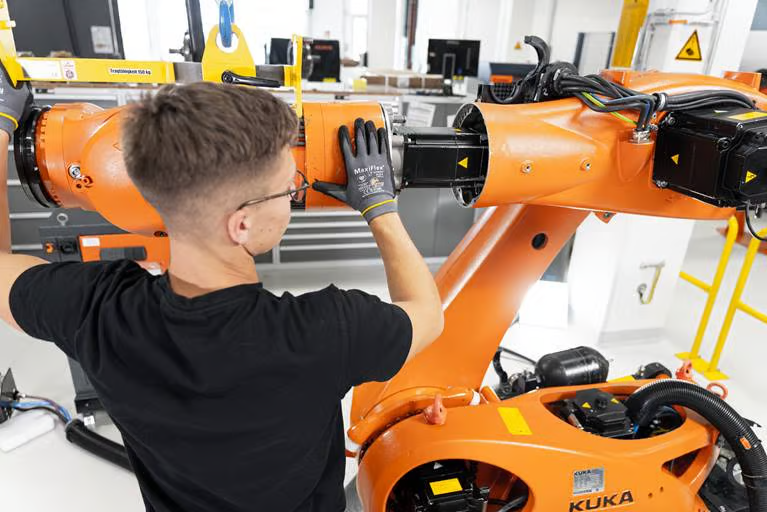
After an ABB robot stops, components should not be replaced directly based on a single alarm. A complete repair process requires combining alarm records, fault occurrence conditions, control cabinet status, robot posture, and peripheral equipment interlocks to determine whether the problem lies in the control system, electrical drive, body mechanics, or production process.
- Controller and Drive System
Inspect the main computer, axis computer, drive unit, power module, I/O modules, and safety circuits of the IRC5 or other control cabinets. Focus on recording the time when alarms such as failure to start, drive enable failure, bus interruption, overcurrent, overvoltage, and temperature occur, and the associated axes.
- Servo Motor and Feedback System
Inspect motor winding insulation, brake release, bearing condition, encoder feedback, motor power cables, and feedback cables. If the robot alarms only in a specific posture, also check whether the body wiring harness is worn, under tension, or has internal broken wires.
- Teach Pendant and Operating System
For touch failure, abnormal buttons, emergency stop circuit alarms, or teach pendant disconnection, inspect the touch panel, keypad membrane, connecting cables, emergency stop contacts, and control cabinet interface separately to avoid misdiagnosing cable faults as teach pendant mainboard faults.
- Robot Body Mechanics
Inspect reducer clearance, lubrication status, brakes, bearings, balancing device, base, and mechanical limits. Issues such as repeat positioning changes, abnormal noise, vibration, and temperature rise should be compared under no-load, loaded, and different postures.
- Post-Repair Verification
After repair, verification should be completed including cold start, low-speed manual operation, automatic operation, repeat positioning, full stroke, safety interlock, and continuous production verification. Parameters, logs, and records of replaced parts should be saved.
The key to ABB robot repair is first determining the fault boundary, then addressing the truly failed components to avoid blindly replacing parts, which expands downtime and repair costs.
Industrial Robot Repair Hotline: +86 18122009539
Contact Repair Engineer: +86 18122009539