
How Often Should Industrial Robot Encoder Batteries Be Replaced? Preventing Low Voltage Alarms and Zero Point Loss
Industrial robot encoder backup batteries are used to maintain the absolute position data of each axis after the controller is powered off. Insufficient battery voltage, loose connectors, or incorrect replacement methods may cause encoder alarms, revolution counter loss, and robot zero point shift. This article introduces the recommended replacement cycle for encoder batteries, handling methods for different alarm stages, and the verification process after replacement.
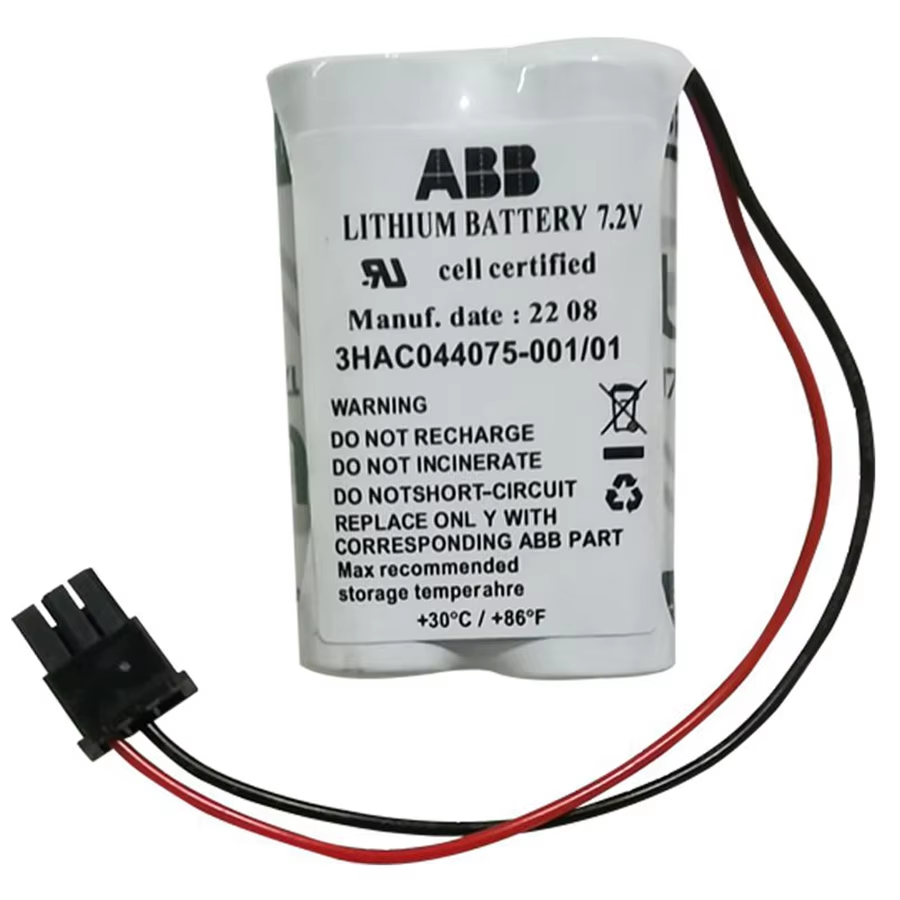
After the industrial robot control cabinet is powered off, absolute encoders typically rely on backup batteries to maintain the position data of each axis. After battery failure, the robot may exhibit low battery voltage warnings, loss of absolute position data, abnormal revolution counters, servo enable failure, or program trajectory deviation.
On-site maintenance recommendation: Encoder batteries should be checked at least once a year. For continuous production equipment, a preventive replacement window of 1 to 2 years is common. The specific cycle should be based on the robot model and equipment manual. When a low voltage warning appears, replace the battery in advance; do not wait until the battery is completely depleted before handling it.
1. What is the function of the encoder battery?
The encoder on each robot axis is used to record the motor rotation angle and mechanical position. When the control cabinet is normally powered on, the encoder is powered by the system; after the control cabinet is powered off, the backup battery continues to maintain the absolute position data. If the backup power supply is interrupted, the controller may be unable to confirm the robot's current mechanical posture, requiring re-execution of position recovery or zero point calibration.
2. Why do different robots have different replacement cycles?
Battery life is related to battery type, capacity, number of encoders, control cabinet power-off time, ambient temperature, and connection line status. Robots that remain powered on for long periods have different battery consumption compared to those frequently powered off. High temperature, humidity, and battery compartment contamination can also shorten battery life. Therefore, replacement timing cannot be judged solely based on the robot brand; the specific body and controller models must also be verified.
3. How often should they be checked and replaced?
It is recommended to include encoder batteries in annual maintenance, checking the battery status, production date, plugs, and wiring at least once a year. For equipment with continuous three-shift production and high downtime costs, preventive replacement can be scheduled on a 1 to 2-year cycle; equipment with lower usage frequency should not go too long without replacement, as batteries naturally age over calendar time.
4. What does a low voltage warning indicate?
A low voltage warning usually indicates that the battery charge has dropped, but the absolute position data may still be valid. At this stage, complete alarm information, robot posture, and the alarming axis number should be recorded, and replacement should be arranged as soon as possible. Timely handling during the low voltage warning stage is generally simpler than recovering the zero point after the battery is completely depleted and can also reduce the risk of overall program position deviation.
5. What happens when the battery completely fails?
When the battery voltage drops to a level where it cannot maintain encoder data, or when the battery line is disconnected while the control cabinet is powered off, the system may lose the absolute position relationship of one or multiple axes. Common manifestations include servo startup failure, the robot requiring an update of the revolution counter or recalibration, inconsistency between the current position and mechanical posture, and overall deviation in existing program points.
6. Why does the alarm persist after replacing the battery?
A new battery can only restore the backup power supply; it cannot automatically retrieve lost position data. If the alarm persists after replacement, possible causes include the alarm not being reset, poor contact in the battery connector, open circuit in the wiring, encoder abnormality, or absolute position data already being invalid. In this case, first check the power supply chain, then perform position recovery according to the requirements of the corresponding control system.
7. Should the battery be replaced with power on or off?
Some robots require the controller to remain in normal power-on state when replacing encoder batteries to avoid complete interruption of the backup power supply during the replacement process; other models have different operational requirements. Before replacement, the corresponding equipment manual must be checked. The method for one robot cannot be directly applied to other brands or models.
8. What preparations are needed before replacement?
Before replacement, record the robot body model, controller model, complete alarm information, alarming axis number, and current mechanical posture. Simultaneously, back up the robot program, system parameters, tool coordinates, workpiece coordinates, load data, and calibration data. Also, take photos of the mechanical scale marks on each axis and the teach pendant position screen to provide reference for inspection in case of position abnormalities.
9. How to choose the correct battery?
The voltage, capacity, chemical type, plug form, wiring polarity, and installation dimensions of the new battery should be consistent with the original configuration. Do not use ordinary batteries of similar shape as temporary substitutes, and do not cut and splice wires to connect battery groups of different specifications. Spare parts stored for too long may also cause capacity degradation; check the production date, expiration date, and appearance before installation.
10. Battery compartment and wiring inspection
When replacing the battery, also check the battery compartment for liquid ingress, corrosion, oil contamination, and terminal oxidation. Confirm that the plug is locked securely and the wiring is not pinched or broken. If multiple robot axes simultaneously show battery-related alarms, priority should be given to checking the common battery group, common connectors, and power supply lines; it is not advisable to directly conclude that multiple encoders are damaged simultaneously.
11. Fault manifestations for different robot brands
FANUC robots may display pulse encoder battery and absolute position-related alarms. ABB robots may display SMB battery, revolution counter, or position status abnormalities. Yaskawa robots may display encoder battery and absolute data-related prompts. The alarm names and recovery menus differ across systems, but the troubleshooting approach is the same: first confirm the battery and wiring, then determine whether the absolute position data is still valid.
12. How to determine if the zero point is lost?
After replacing the battery and clearing the alarm, check the mechanical scale marks on each axis, the angle displayed on the teach pendant, fixed reference points, and tool TCP. If the robot shows significant deviation when returning to the original reference position, or if all program points shift in a similar direction, priority should be given to checking the zero point, revolution counter, tool coordinates, and workpiece coordinates. Do not directly modify a large number of program points.
13. How to handle lost position data?
If it is confirmed that absolute position data has been lost, choose the appropriate method based on the robot brand and available on-site documentation: revolution counter update, single-axis calibration, scale mark calibration, origin recovery, or professional instrument calibration. For axes where the motor, encoder, or reducer has been replaced, the zero point must be reconfirmed based on the actual mechanical installation position; calibration data from other robots cannot be directly written.
14. Post-replacement restart verification
After completing battery replacement and alarm handling, confirm that the battery warning has disappeared, the current axis angles are reasonable and correspond to the mechanical posture. Then, perform low-speed testing of each axis in positive and negative directions, run to fixed reference points to check TCP, and execute the original program at low speed with no load. After confirming normal trajectory, gradually increase speed and perform production verification with load.
15. Establishing battery replacement records
Battery maintenance records should include the robot serial number, body model, controller model, battery specifications, replacement date, alarm status, and operator. Also, mark the next planned inspection time on the equipment, and save system backups and zero point data to avoid lacking recovery basis in case of subsequent battery failure.
16. Summary
Industrial robot encoder batteries should be checked at least once a year. For continuous production equipment, a preventive replacement window of 1 to 2 years is common, with the final cycle based on the corresponding equipment manual. After a low voltage warning appears, handle it as soon as possible; do not continue operation until the backup power supply is completely interrupted. After replacement is completed, also check the alarm status, absolute position, robot zero point, TCP, and program trajectory. Confirm that position data is accurate before resuming automatic production.
Repair Consultation
If you need to handle industrial robot encoder battery alarms, absolute position loss, revolution counter abnormalities, or robot zero point recovery, please provide the robot brand, body model, controller model, complete alarm screen capture, faulty axis number, and photos of the robot's current posture.
Industrial Robot Repair Hotline: +86 18122009539
Contact Repair Engineer: +86 18122009539